Sponge Filter vs Hang-On-Back Filter for a 5-Gallon Betta Tank
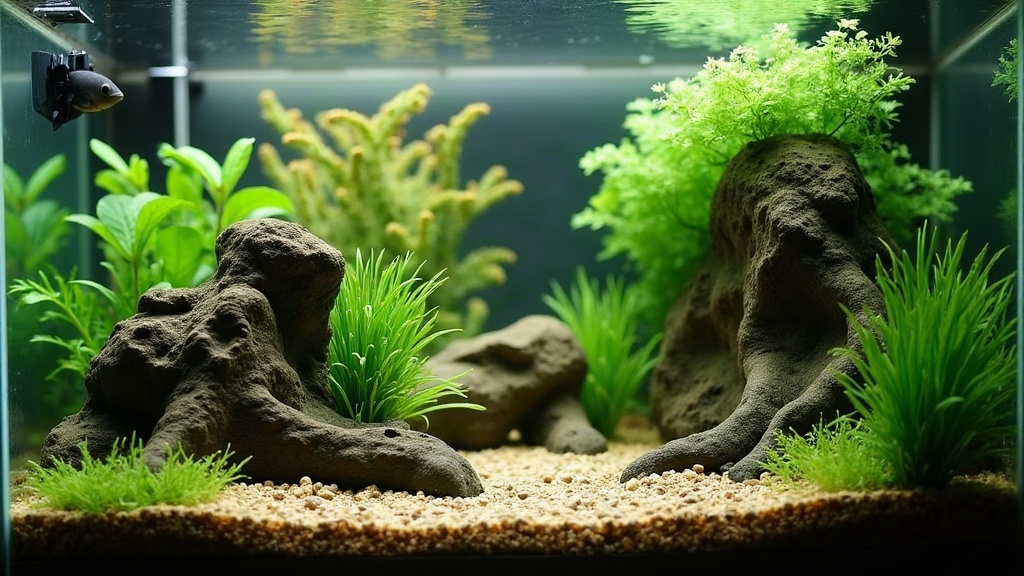
If you’re setting up a 5-gallon planted betta tank, go with a sponge filter. For most keepers it’s simply the better option: gentle flow, plenty of biological capacity, and it costs next to nothing. That said, a hang-on-back (HOB) filter isn’t off the table either, as long as you pick a low-flow model and baffle the outflow so it doesn’t turn your tank into a washing machine. Really, the “right” answer comes down to your plants, your betta’s fin type, and how much maintenance you’re willing to sign up for.
Why Filter Choice Matters So Much in a 5-Gallon Tank
Small tanks don’t have much water to work with, so there’s very little room to dilute waste. That means filtration quality matters a lot more here than it would in, say, a 20-gallon community tank. On top of that, bettas didn’t evolve for rushing rivers, they came from slow-moving rice paddies and shallow puddles, so they’re just not built to fight strong currents. Long-finned males especially will wear themselves out trying to swim against a filter that’s too aggressive. So filtering a nano betta tank really becomes a balancing act: enough biological capacity to keep the water clean, but gentle enough that your fish isn’t getting tossed around all day.
Sponge Filter: The Popular Choice for Betta Tanks
A sponge filter works with an air pump pulling water through a porous foam block. Simple mechanism, but it gives you both mechanical and biological filtration in one cheap unit.
Pros:
- Gentle flow. You can dial it down with an air valve, which makes it ideal for bettas and for delicate plant stems that would otherwise get whipped around
- Huge surface area for beneficial bacteria, which keeps ammonia and nitrite in check
- Fry-safe. No intake risk for baby fish or shrimp, so it’s a solid pick if you’re thinking about breeding or adding a cleanup crew down the line
- Cheap and simple. Usually somewhere between $6 and $15, and there’s no motor to burn out or replace
- Doubles as a hiding spot. Don’t be surprised if your betta parks himself right next to (or under) the sponge for a nap
Cons:
- You need an external air pump, which adds a slight hum (though quieter models exist if noise bothers you)
- You’ll need to squeeze and rinse the sponge in old tank water every 1-2 weeks, it’s not a “set and forget” system
- Surface agitation is less immediate, so in a heavily planted tank doing a lot of nighttime photosynthesis, you may need a second way to boost oxygen exchange
Hang-On-Back Filter: More Water Turnover, More Flow
An HOB filter clips onto the back rim of the tank. It siphons water up, runs it through a cartridge, then dumps it back in via that little waterfall-style outflow you’ve probably seen in every pet store display tank.
Pros:
- Higher turnover rate, which often means clearer water, faster
- Easy cartridge swaps for mechanical filtration, no rinsing sponges by hand
- Built-in surface agitation, which helps with oxygenation, especially in warmer tanks
- Compact footprint. Since it hangs on the back, it doesn’t eat into your usable tank space
Cons:
- Flow is often too strong for a 5-gallon tank, even set to the lowest setting. That’s enough to stress out a betta and shred something like dwarf hairgrass or a floating plant’s roots
- Cartridges usually skimp on biological media, and those all-in-one “combo” cartridges make it tough to build up a lasting bacterial colony
- Without a sponge pre-filter or mesh guard, fry and shrimp can get sucked right into the intake
- That waterfall return can get surprisingly loud in such a small footprint, more splashing than you’d expect
Which One Should You Choose?
Choose a sponge filter if:
- You’ve got a long-finned betta (veiltail, halfmoon, crowntail)
- You’re keeping delicate or rooted plants like Java fern, anubias, or crypts
- You’re planning to add shrimp eventually, or breed bettas
- You’d rather keep things cheap and quiet
Choose an HOB filter if:
- You already own one and are willing to baffle the output with a sponge or filter floss to slow it down
- Your tank has hardy, current-tolerant plants (anubias tied to driftwood handles turbulence fine)
- You care more about visible water clarity and turnover than absolute silence
Tips for Making Either Filter Betta-Safe
- Add a pre-filter sponge to any HOB intake. It protects fry and slows the flow at the same time
- Angle the HOB output toward the glass, or use a flow deflector to break up the current before it hits open water
- Position sponge filters in a back corner, so your betta still has open swimming room up front
- Test the flow with your betta in mind. If he’s struggling to hold his position in the middle of the tank, that’s your answer, it’s too strong
Final Verdict
For a 5-gallon planted betta tank, the sponge filter is the safer, more forgiving pick. It protects fins, builds strong biofiltration, and leaves your aquascape alone. An HOB filter can be made to work, sure, but you’ll spend more time tweaking it to get the flow down to something a betta can actually tolerate. When you’re not sure which way to go, start gentle. You can always crank up the flow later if needed, but there’s no undoing a stressed-out betta or a plant that’s already been torn to shreds.